The Economic Engine: What May Actually Pumps Into Indiana
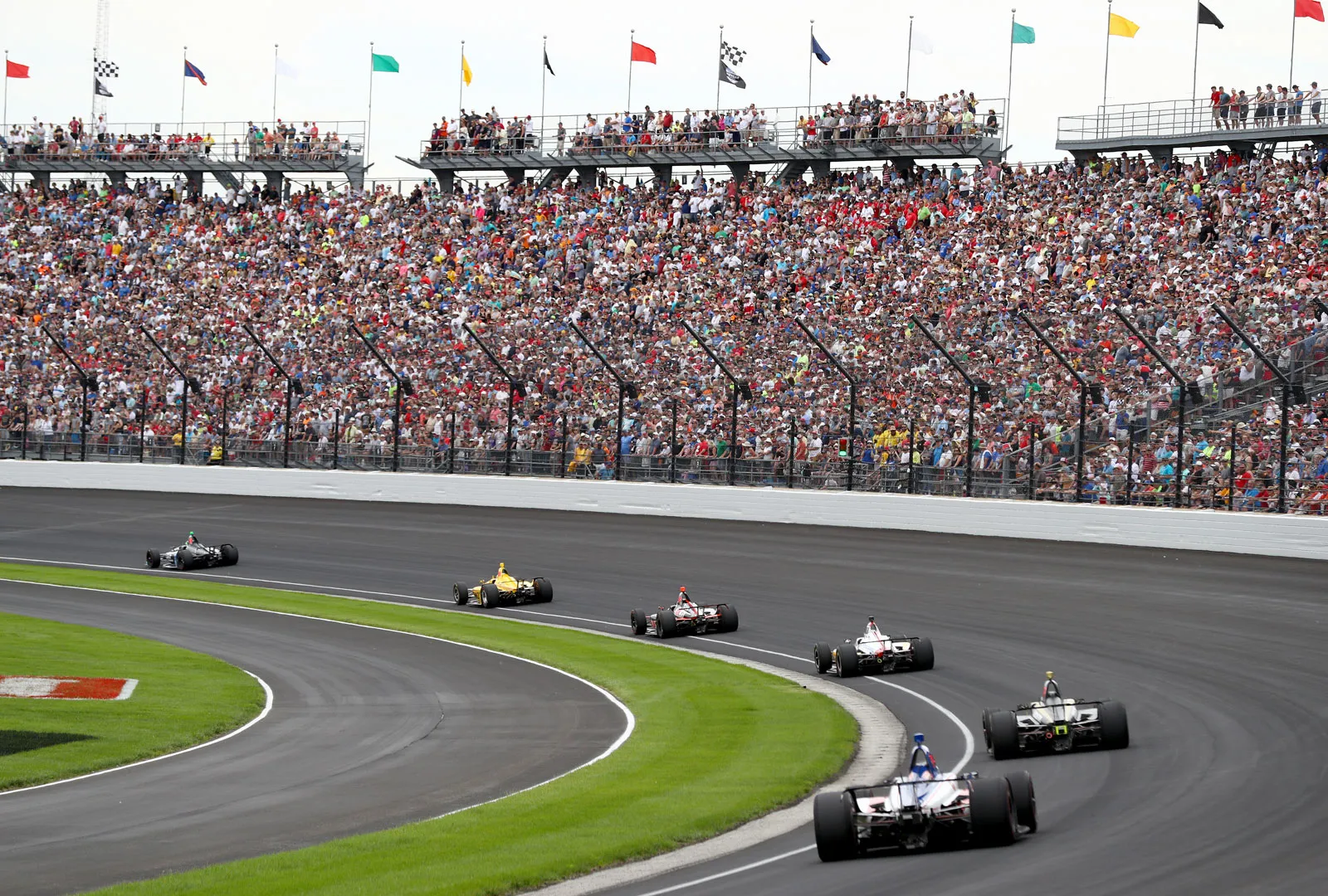
The Indianapolis Motor Speedway is the highest-impact sports venue in the state, and the Indianapolis 500 is the centerpiece event.
According to the most recent economic impact study from the Indiana University Public Policy Institute (released October 2023, covering June 2022 through May 2023), IMS generates $1.058 billion in annual economic contribution for Indiana. Of that, $566.4 million comes from the Month of May alone, meaning the run-up to and including the Indy 500 accounts for more than half of the track's annual impact.
A few more verified figures from that study worth knowing:
3,783 full-time-equivalent jobs are sustained by Month of May activities, generating $155.2 million in labor income.
IMS supports 8,440 FTE jobs statewide across the full year.
Race-day attendance was announced at 330,000 spectators by Roger Penske, with close to 500,000 total visitors across the Month of May.
That is a real, measurable surge of out-of-town money flowing into Marion County hotels, restaurants, bars, and rental properties every spring. If you own real estate within walking or biking distance of the track, you have a seat at the table.
Why Investors Target Speedway Specifically
The Town of Speedway is its own municipality. It sits inside the boundaries of Indianapolis, but it operates as an "excluded city" under Unigov, with its own elected town council, its own police and fire departments, its own water and wastewater systems, and its own school district.
That last piece matters a lot. The School Town of Speedway is the highest-rated public school corporation in Marion County. Speedway High School was named a National Blue Ribbon school in 2020. For investors, that translates to durable long-term rental demand from families who want Marion County addresses without putting their kids in IPS.
Then there is the racetrack itself, sitting at the geographic center of town.
Investors generally pursue Speedway in three ways:
1. The Short-Term Rental Play
You buy something within walking or biking distance of the gates and list it on Airbnb or Vrbo. You earn modest baseline revenue 10 months a year, then capture a massive premium during May and any other big race weekends.
2. The Long-Term Rental Play
You buy a stable single-family home, often a three-bedroom, one-bath build from the mid-20th century, and rent it to a family on a 12-month lease. The schools and proximity to downtown Indy keep occupancy high. The cash flow is steadier and the operational lift is lower.
3. The Race-Weekend Yard Parking Hustle
A hyper-local Speedway quirk. Homeowners with large front or back lawns charge $20 to $50+ per car for race-day parking. It is mostly cash, it is mostly tax-headache-free at small volumes, and a well-located yard can pull in a few thousand dollars over a single weekend without ever signing a lease.
Many Speedway investors combine strategies. A long-term tenant pays the mortgage 11 months a year, and the owner negotiates a vacancy clause around Memorial Day weekend to capture the STR premium.
The Math: LTR vs. STR on a $260,000 Speedway Purchase
Speedway's median sale price has been bouncing in the $249K to $281K range over the past 12 months depending on the data source, so $260,000 is a fair illustration for a typical investor-grade three-bedroom.
Here is how the returns roughly stack up. Treat these as planning estimates, not guarantees. Every property runs its own numbers.
Return Comparison (Based on a $260,000 Purchase Price)
Metric | Long-Term Rental (LTR) | Short-Term Rental (STR) |
|---|---|---|
Gross Annual Revenue | $16,500 ($1,375/month) | ~$34,000 (base year + race premium) |
May / Race Weekend Revenue | Included in monthly rent | $6,500 to $8,000 (May alone) |
Operating Expenses | ~$4,950 (30%: taxes, insurance, maintenance) | ~$15,300 (45%: utilities, cleaning, mgmt, STR taxes) |
Net Operating Income (NOI) | $11,550 | $18,700 |
Unleveraged Cap Rate | ~4.4% | ~7.2% |
The May Premium
A Speedway home that rents for $150 a night in October can command $1,000 to $1,500 a night during Indy 500 weekend, with a 4-night minimum standard. A single Memorial Day weekend on a well-located, well-furnished STR can produce $4,000 to $6,000 of revenue, and that is before the IndyCar Grand Prix, Carb Day, and any auxiliary May business.
That is the math that pulls investors toward STRs in this specific zip code.
The Financial Catch Most STR Pitches Skip
A 7.2% cap rate beats a 4.4% cap rate on paper. The real picture is messier.
Mortgage rates and cash flow. With 30-year rates still hovering in the high 6s, putting 20% down on a $260,000 Speedway property and renting it long-term often produces tight or break-even monthly cash flow. The numbers improve materially with an STR, but only if the property actually performs.
STR taxes are not optional. Indianapolis hosts must collect and remit 7% state sales tax plus a 10% Marion County innkeeper's tax on every booking, for a combined 17% lodging tax. Major platforms like Airbnb and Vrbo collect some of this automatically, but you are ultimately responsible.
Permitting and registration. The city now requires a short-term rental permit through the Department of Business & Neighborhood Services (current initial fee is $150), plus registration with the Indiana Department of Revenue and a Retail Merchant Certificate. There is also a two-night minimum stay rule and required neighbor notification.
Operations are a real job. Cleaning between every stay, dynamic pricing for May, guest communication, insurance for commercial use. Most STR underperformance traces back to operators who underestimated this part.
Market saturation. Speedway has been a known investor target for years. A lot of inventory near the track is already STR-optimized. New entrants need to compete on the experience, not just the location.
None of this is a reason to skip the play. It is a reason to underwrite carefully and pick the right property.
What This Looks Like in Practice
Two profiles tend to do well in Speedway:
The first-time investor who buys a long-term rental in a strong Speedway block, builds equity for 3 to 5 years, then either refinances and adds an STR or converts the existing property once they have operational confidence.
The experienced operator who already runs short-term rentals elsewhere and adds a Speedway property as a high-yield, race-calendar-driven asset.
The strategy that does not work as often: a brand-new investor who buys a stretched-priced Speedway home assuming the May premium will rescue mediocre underwriting. The May spike is real. It is not large enough to fix bad math everywhere else.
Talk to an Investor-Agent Before You Buy
Every agent at Roots Realty Co. is an active real estate investor. We do not just sell Speedway, we underwrite Speedway, and we have helped clients buy both LTRs and STRs inside the town limits.
If you are evaluating a specific property, or trying to decide whether short-term or long-term is the right fit for your portfolio, a 30-minute consultation will save you a lot of guesswork.
We will walk through your numbers, your financing, and what is actually for sale in Speedway right now.