Financing an investment property in Indianapolis in 2025 looks different than it did even a few years ago. With shifting mortgage rates, rising insurance premiums, and a competitive rental market, investors need to understand the loan options that actually work — and how lenders evaluate deals today.
Whether you’re buying your first rental or scaling your portfolio, this guide will break down your best financing options, how to qualify, and what lenders look for specifically in the Indianapolis market.
Let’s jump in.
Why Financing Strategy Matters in Indianapolis
Indy’s rental market is one of the strongest in the Midwest. Investors love it because of:
Affordable entry prices
High rental demand
Stable job growth
Strong rent-to-price ratios
Diverse neighborhoods and property types
But getting financing wrong can kill cash flow fast.
The better your financing strategy, the better your long-term ROI.
For year-end financial planning, pair this with our tax guide:
Real Estate Investor Tax Strategies 2025: Indiana
Loan Options for Indianapolis Investment Properties in 2025
1. Conventional Investment Loans (Most Common)
These are the go-to option for most Indy investors.
Requirements:
15–25% down
Strong credit (680–740+)
Lower debt-to-income ratio
Two years of landlord or rent history (helpful but not required)
Benefits:
Best long-term interest rates
Lower fees compared to hard money
Ideal for buy-and-hold rentals
Downside:
Stricter underwriting
Limited to ~10 financed properties for many lenders
2. DSCR Loans (Debt Service Coverage Ratio)
DSCR loans exploded in popularity in Indy because they qualify the property, not the borrower.
How they work:
Lenders look at whether rent covers the mortgage — not your personal income.
Typical requirements:
20–25% down
DSCR of 1.0–1.2+
Market rent verification
Fair–good credit (660–700+)
Benefits:
Faster closings
Great for scaling portfolios
More flexible underwriting
Downside:
Higher interest rates
Prepayment penalties common
If your property cash flows well, DSCR can be a game changer.
3. Hard Money Loans (Best for Flips + BRRRR)
Hard money is designed for short-term use — typically 6–12 months.
Great for:
Flips
BRRRR projects
Heavy rehabs
Off-market deals needing fast closings
Benefits:
Close in days
Flexible condition requirements
Easy approval
Downside:
High interest rates
Points + fees
Not for long-term holds
Most Indy flippers use hard money when acquiring distressed properties.
4. Portfolio Loans (Local Banks + Credit Unions)
Indy has a strong network of local lenders who love working with investors.
Why they’re great:
Flexible underwriting
Relationship-based lending
Can finance multiple properties under one loan
Great for small multi-family properties
Requirements vary, but they’re often friendlier than national lenders.
5. Commercial Loans (5+ Units)
If you’re buying an apartment building or mixed-use property, you’ll use commercial financing.
Key features:
NOI (net operating income) determines approval
20–30% down
Higher fees but scalable
Often interest-only options
Perfect for investors transitioning into multi-unit or commercial holdings.
6. Home Equity Loans & HELOCs
If you own a home (or other rentals) with strong equity, you can borrow against it.
Use cases:
Down payment source
Renovation funds
Cash purchase leverage
Benefits:
Lower rates than investment loans
Flexible use of funds
Just be careful not to over-leverage.
7. Seller Financing (Rare, But Powerful)
Sometimes an Indy seller will finance the deal directly — especially:
Tired landlords
Distressed property owners
Sellers with lots of equity
Terms can be extremely favorable:
Low down payments
Negotiable rates
Flexible underwriting
Requires negotiation savvy — but worth exploring.
What Lenders Look for in Indy Investment Deals
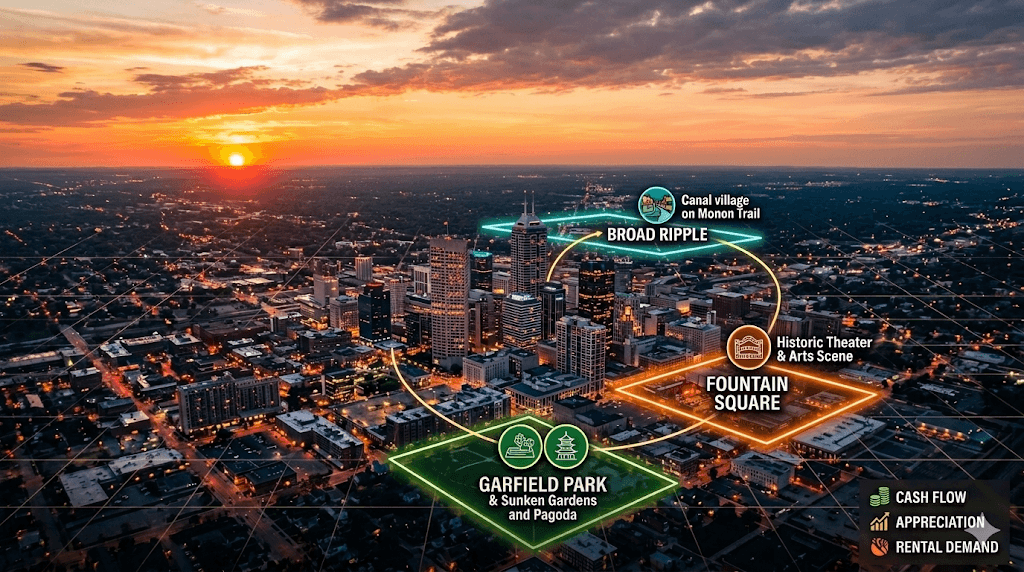
Whether you’re buying a $150K single-family in Warren Township or a $350K duplex in Garfield Park, lenders pay attention to:
1. Cash Flow & Rent Strength
Healthy rent-to-price ratios make Indy lending attractive.
2. Property Condition
Older Indy homes (pre-1950) often trigger underwriting scrutiny around:
Roof
Electrical
Foundation
Plumbing
3. Your Credit & Reserves
Most lenders want at least 2–6 months of reserves per property.
4. Experience
Not required, but helpful — especially for DSCR or portfolio loans.
Down Payment Requirements for Indy Investment Properties
Here’s what you can expect in 2025:
Conventional loan: 15–25% down
DSCR loan: 20–25% down
Hard money: 10–20% down + rehab costs
Commercial loan: 20–30% down
Portfolio loan: varies (often 15–25%)
More down = better rates and terms.
How to Choose the Right Financing Strategy
Choose Conventional Loans If:
You want long-term rentals
You have strong credit
You prefer lower rates
Choose DSCR Loans If:
You want to scale quickly
You want the property to qualify itself
You have variable income
Choose Hard Money If:
You’re flipping
You’re doing BRRRR
The home needs major rehab
Choose Portfolio Loans If:
You’re building a small multi-family portfolio
You want a relationship lender
You prefer flexibility
Choose Commercial Loans If:
You’re buying 5+ units
You’re moving into larger-scale investing
Year-End Financing Moves for 2025 Investors
As you prepare for tax season and 2026 planning, make sure you also revisit:
Year-End Portfolio Check-Up for Indy Investors
This pairs perfectly with your financing review and helps optimize:
Cash flow strategy
Leverage position
Renovation plans
Debt structure
Exit options
FAQs: Financing Indy Investment Properties
What credit score do I need to buy an investment property?
Typically 680+ for conventional, 660+ for DSCR.
Can I use projected rent to qualify?
Yes — with DSCR loans or conventional with rental comps.
Are interest rates higher for investment properties?
Yes, usually 0.5–1.5% higher than owner-occupied loans.
Can I use an FHA loan for investment properties?
Only if you house hack a multi-unit and live in one unit.
How many loans can an investor get?
Most can get up to 10 conventional loans — portfolio lenders can extend beyond that.
Final Thoughts
Financing your Indianapolis investment property in 2025 isn’t one-size-fits-all — but the right strategy can dramatically boost your cash flow and long-term returns. Understanding your loan options, preparing your finances, and working with experienced investor-friendly lenders will set you up for success.
If you’re ready to explore properties, compare financing options, or build a long-term Indy investment plan, Roots Realty Co. is here to guide you.
Investor Resources: https://rootsrealty.co/invest/investor-resources
Join our newsletter: https://rootsrealty.co/join-roots-newsletter

Financing an investment property in Indianapolis in 2025 looks different than it did even a few years ago. With shifting mortgage rates, rising insurance premiums, and a competitive rental market, investors need to understand the loan options that actually work — and how lenders evaluate deals today.
Whether you’re buying your first rental or scaling your portfolio, this guide will break down your best financing options, how to qualify, and what lenders look for specifically in the Indianapolis market.
Let’s jump in.
Why Financing Strategy Matters in Indianapolis
Indy’s rental market is one of the strongest in the Midwest. Investors love it because of:
Affordable entry prices
High rental demand
Stable job growth
Strong rent-to-price ratios
Diverse neighborhoods and property types
But getting financing wrong can kill cash flow fast.
The better your financing strategy, the better your long-term ROI.
For year-end financial planning, pair this with our tax guide:
Real Estate Investor Tax Strategies 2025: Indiana
Loan Options for Indianapolis Investment Properties in 2025
1. Conventional Investment Loans (Most Common)
These are the go-to option for most Indy investors.
Requirements:
15–25% down
Strong credit (680–740+)
Lower debt-to-income ratio
Two years of landlord or rent history (helpful but not required)
Benefits:
Best long-term interest rates
Lower fees compared to hard money
Ideal for buy-and-hold rentals
Downside:
Stricter underwriting
Limited to ~10 financed properties for many lenders
2. DSCR Loans (Debt Service Coverage Ratio)
DSCR loans exploded in popularity in Indy because they qualify the property, not the borrower.
How they work:
Lenders look at whether rent covers the mortgage — not your personal income.
Typical requirements:
20–25% down
DSCR of 1.0–1.2+
Market rent verification
Fair–good credit (660–700+)
Benefits:
Faster closings
Great for scaling portfolios
More flexible underwriting
Downside:
Higher interest rates
Prepayment penalties common
If your property cash flows well, DSCR can be a game changer.
3. Hard Money Loans (Best for Flips + BRRRR)
Hard money is designed for short-term use — typically 6–12 months.
Great for:
Flips
BRRRR projects
Heavy rehabs
Off-market deals needing fast closings
Benefits:
Close in days
Flexible condition requirements
Easy approval
Downside:
High interest rates
Points + fees
Not for long-term holds
Most Indy flippers use hard money when acquiring distressed properties.
4. Portfolio Loans (Local Banks + Credit Unions)
Indy has a strong network of local lenders who love working with investors.
Why they’re great:
Flexible underwriting
Relationship-based lending
Can finance multiple properties under one loan
Great for small multi-family properties
Requirements vary, but they’re often friendlier than national lenders.
5. Commercial Loans (5+ Units)
If you’re buying an apartment building or mixed-use property, you’ll use commercial financing.
Key features:
NOI (net operating income) determines approval
20–30% down
Higher fees but scalable
Often interest-only options
Perfect for investors transitioning into multi-unit or commercial holdings.
6. Home Equity Loans & HELOCs
If you own a home (or other rentals) with strong equity, you can borrow against it.
Use cases:
Down payment source
Renovation funds
Cash purchase leverage
Benefits:
Lower rates than investment loans
Flexible use of funds
Just be careful not to over-leverage.
7. Seller Financing (Rare, But Powerful)
Sometimes an Indy seller will finance the deal directly — especially:
Tired landlords
Distressed property owners
Sellers with lots of equity
Terms can be extremely favorable:
Low down payments
Negotiable rates
Flexible underwriting
Requires negotiation savvy — but worth exploring.
What Lenders Look for in Indy Investment Deals
Whether you’re buying a $150K single-family in Warren Township or a $350K duplex in Garfield Park, lenders pay attention to:
1. Cash Flow & Rent Strength
Healthy rent-to-price ratios make Indy lending attractive.
2. Property Condition
Older Indy homes (pre-1950) often trigger underwriting scrutiny around:
Roof
Electrical
Foundation
Plumbing
3. Your Credit & Reserves
Most lenders want at least 2–6 months of reserves per property.
4. Experience
Not required, but helpful — especially for DSCR or portfolio loans.
Down Payment Requirements for Indy Investment Properties
Here’s what you can expect in 2025:
Conventional loan: 15–25% down
DSCR loan: 20–25% down
Hard money: 10–20% down + rehab costs
Commercial loan: 20–30% down
Portfolio loan: varies (often 15–25%)
More down = better rates and terms.
How to Choose the Right Financing Strategy
Choose Conventional Loans If:
You want long-term rentals
You have strong credit
You prefer lower rates
Choose DSCR Loans If:
You want to scale quickly
You want the property to qualify itself
You have variable income
Choose Hard Money If:
You’re flipping
You’re doing BRRRR
The home needs major rehab
Choose Portfolio Loans If:
You’re building a small multi-family portfolio
You want a relationship lender
You prefer flexibility
Choose Commercial Loans If:
You’re buying 5+ units
You’re moving into larger-scale investing
Year-End Financing Moves for 2025 Investors
As you prepare for tax season and 2026 planning, make sure you also revisit:
Year-End Portfolio Check-Up for Indy Investors
This pairs perfectly with your financing review and helps optimize:
Cash flow strategy
Leverage position
Renovation plans
Debt structure
Exit options
FAQs: Financing Indy Investment Properties
What credit score do I need to buy an investment property?
Typically 680+ for conventional, 660+ for DSCR.
Can I use projected rent to qualify?
Yes — with DSCR loans or conventional with rental comps.
Are interest rates higher for investment properties?
Yes, usually 0.5–1.5% higher than owner-occupied loans.
Can I use an FHA loan for investment properties?
Only if you house hack a multi-unit and live in one unit.
How many loans can an investor get?
Most can get up to 10 conventional loans — portfolio lenders can extend beyond that.
Final Thoughts
Financing your Indianapolis investment property in 2025 isn’t one-size-fits-all — but the right strategy can dramatically boost your cash flow and long-term returns. Understanding your loan options, preparing your finances, and working with experienced investor-friendly lenders will set you up for success.
If you’re ready to explore properties, compare financing options, or build a long-term Indy investment plan, Roots Realty Co. is here to guide you.
Investor Resources: https://rootsrealty.co/invest/investor-resources
Join our newsletter: https://rootsrealty.co/join-roots-newsletter
Financing an investment property in Indianapolis in 2025 looks different than it did even a few years ago. With shifting mortgage rates, rising insurance premiums, and a competitive rental market, investors need to understand the loan options that actually work — and how lenders evaluate deals today.
Whether you’re buying your first rental or scaling your portfolio, this guide will break down your best financing options, how to qualify, and what lenders look for specifically in the Indianapolis market.
Let’s jump in.
Why Financing Strategy Matters in Indianapolis
Indy’s rental market is one of the strongest in the Midwest. Investors love it because of:
Affordable entry prices
High rental demand
Stable job growth
Strong rent-to-price ratios
Diverse neighborhoods and property types
But getting financing wrong can kill cash flow fast.
The better your financing strategy, the better your long-term ROI.
For year-end financial planning, pair this with our tax guide:
Real Estate Investor Tax Strategies 2025: Indiana
Loan Options for Indianapolis Investment Properties in 2025
1. Conventional Investment Loans (Most Common)
These are the go-to option for most Indy investors.
Requirements:
15–25% down
Strong credit (680–740+)
Lower debt-to-income ratio
Two years of landlord or rent history (helpful but not required)
Benefits:
Best long-term interest rates
Lower fees compared to hard money
Ideal for buy-and-hold rentals
Downside:
Stricter underwriting
Limited to ~10 financed properties for many lenders
2. DSCR Loans (Debt Service Coverage Ratio)
DSCR loans exploded in popularity in Indy because they qualify the property, not the borrower.
How they work:
Lenders look at whether rent covers the mortgage — not your personal income.
Typical requirements:
20–25% down
DSCR of 1.0–1.2+
Market rent verification
Fair–good credit (660–700+)
Benefits:
Faster closings
Great for scaling portfolios
More flexible underwriting
Downside:
Higher interest rates
Prepayment penalties common
If your property cash flows well, DSCR can be a game changer.
3. Hard Money Loans (Best for Flips + BRRRR)
Hard money is designed for short-term use — typically 6–12 months.
Great for:
Flips
BRRRR projects
Heavy rehabs
Off-market deals needing fast closings
Benefits:
Close in days
Flexible condition requirements
Easy approval
Downside:
High interest rates
Points + fees
Not for long-term holds
Most Indy flippers use hard money when acquiring distressed properties.
4. Portfolio Loans (Local Banks + Credit Unions)
Indy has a strong network of local lenders who love working with investors.
Why they’re great:
Flexible underwriting
Relationship-based lending
Can finance multiple properties under one loan
Great for small multi-family properties
Requirements vary, but they’re often friendlier than national lenders.
5. Commercial Loans (5+ Units)
If you’re buying an apartment building or mixed-use property, you’ll use commercial financing.
Key features:
NOI (net operating income) determines approval
20–30% down
Higher fees but scalable
Often interest-only options
Perfect for investors transitioning into multi-unit or commercial holdings.
6. Home Equity Loans & HELOCs
If you own a home (or other rentals) with strong equity, you can borrow against it.
Use cases:
Down payment source
Renovation funds
Cash purchase leverage
Benefits:
Lower rates than investment loans
Flexible use of funds
Just be careful not to over-leverage.
7. Seller Financing (Rare, But Powerful)
Sometimes an Indy seller will finance the deal directly — especially:
Tired landlords
Distressed property owners
Sellers with lots of equity
Terms can be extremely favorable:
Low down payments
Negotiable rates
Flexible underwriting
Requires negotiation savvy — but worth exploring.
What Lenders Look for in Indy Investment Deals
Whether you’re buying a $150K single-family in Warren Township or a $350K duplex in Garfield Park, lenders pay attention to:
1. Cash Flow & Rent Strength
Healthy rent-to-price ratios make Indy lending attractive.
2. Property Condition
Older Indy homes (pre-1950) often trigger underwriting scrutiny around:
Roof
Electrical
Foundation
Plumbing
3. Your Credit & Reserves
Most lenders want at least 2–6 months of reserves per property.
4. Experience
Not required, but helpful — especially for DSCR or portfolio loans.
Down Payment Requirements for Indy Investment Properties
Here’s what you can expect in 2025:
Conventional loan: 15–25% down
DSCR loan: 20–25% down
Hard money: 10–20% down + rehab costs
Commercial loan: 20–30% down
Portfolio loan: varies (often 15–25%)
More down = better rates and terms.
How to Choose the Right Financing Strategy
Choose Conventional Loans If:
You want long-term rentals
You have strong credit
You prefer lower rates
Choose DSCR Loans If:
You want to scale quickly
You want the property to qualify itself
You have variable income
Choose Hard Money If:
You’re flipping
You’re doing BRRRR
The home needs major rehab
Choose Portfolio Loans If:
You’re building a small multi-family portfolio
You want a relationship lender
You prefer flexibility
Choose Commercial Loans If:
You’re buying 5+ units
You’re moving into larger-scale investing
Year-End Financing Moves for 2025 Investors
As you prepare for tax season and 2026 planning, make sure you also revisit:
Year-End Portfolio Check-Up for Indy Investors
This pairs perfectly with your financing review and helps optimize:
Cash flow strategy
Leverage position
Renovation plans
Debt structure
Exit options
FAQs: Financing Indy Investment Properties
What credit score do I need to buy an investment property?
Typically 680+ for conventional, 660+ for DSCR.
Can I use projected rent to qualify?
Yes — with DSCR loans or conventional with rental comps.
Are interest rates higher for investment properties?
Yes, usually 0.5–1.5% higher than owner-occupied loans.
Can I use an FHA loan for investment properties?
Only if you house hack a multi-unit and live in one unit.
How many loans can an investor get?
Most can get up to 10 conventional loans — portfolio lenders can extend beyond that.
Final Thoughts
Financing your Indianapolis investment property in 2025 isn’t one-size-fits-all — but the right strategy can dramatically boost your cash flow and long-term returns. Understanding your loan options, preparing your finances, and working with experienced investor-friendly lenders will set you up for success.
If you’re ready to explore properties, compare financing options, or build a long-term Indy investment plan, Roots Realty Co. is here to guide you.
Investor Resources: https://rootsrealty.co/invest/investor-resources
Join our newsletter: https://rootsrealty.co/join-roots-newsletter
Financing an investment property in Indianapolis in 2025 looks different than it did even a few years ago. With shifting mortgage rates, rising insurance premiums, and a competitive rental market, investors need to understand the loan options that actually work — and how lenders evaluate deals today.
Whether you’re buying your first rental or scaling your portfolio, this guide will break down your best financing options, how to qualify, and what lenders look for specifically in the Indianapolis market.
Let’s jump in.
Why Financing Strategy Matters in Indianapolis
Indy’s rental market is one of the strongest in the Midwest. Investors love it because of:
Affordable entry prices
High rental demand
Stable job growth
Strong rent-to-price ratios
Diverse neighborhoods and property types
But getting financing wrong can kill cash flow fast.
The better your financing strategy, the better your long-term ROI.
For year-end financial planning, pair this with our tax guide:
Real Estate Investor Tax Strategies 2025: Indiana
Loan Options for Indianapolis Investment Properties in 2025
1. Conventional Investment Loans (Most Common)
These are the go-to option for most Indy investors.
Requirements:
15–25% down
Strong credit (680–740+)
Lower debt-to-income ratio
Two years of landlord or rent history (helpful but not required)
Benefits:
Best long-term interest rates
Lower fees compared to hard money
Ideal for buy-and-hold rentals
Downside:
Stricter underwriting
Limited to ~10 financed properties for many lenders
2. DSCR Loans (Debt Service Coverage Ratio)
DSCR loans exploded in popularity in Indy because they qualify the property, not the borrower.
How they work:
Lenders look at whether rent covers the mortgage — not your personal income.
Typical requirements:
20–25% down
DSCR of 1.0–1.2+
Market rent verification
Fair–good credit (660–700+)
Benefits:
Faster closings
Great for scaling portfolios
More flexible underwriting
Downside:
Higher interest rates
Prepayment penalties common
If your property cash flows well, DSCR can be a game changer.
3. Hard Money Loans (Best for Flips + BRRRR)
Hard money is designed for short-term use — typically 6–12 months.
Great for:
Flips
BRRRR projects
Heavy rehabs
Off-market deals needing fast closings
Benefits:
Close in days
Flexible condition requirements
Easy approval
Downside:
High interest rates
Points + fees
Not for long-term holds
Most Indy flippers use hard money when acquiring distressed properties.
4. Portfolio Loans (Local Banks + Credit Unions)
Indy has a strong network of local lenders who love working with investors.
Why they’re great:
Flexible underwriting
Relationship-based lending
Can finance multiple properties under one loan
Great for small multi-family properties
Requirements vary, but they’re often friendlier than national lenders.
5. Commercial Loans (5+ Units)
If you’re buying an apartment building or mixed-use property, you’ll use commercial financing.
Key features:
NOI (net operating income) determines approval
20–30% down
Higher fees but scalable
Often interest-only options
Perfect for investors transitioning into multi-unit or commercial holdings.
6. Home Equity Loans & HELOCs
If you own a home (or other rentals) with strong equity, you can borrow against it.
Use cases:
Down payment source
Renovation funds
Cash purchase leverage
Benefits:
Lower rates than investment loans
Flexible use of funds
Just be careful not to over-leverage.
7. Seller Financing (Rare, But Powerful)
Sometimes an Indy seller will finance the deal directly — especially:
Tired landlords
Distressed property owners
Sellers with lots of equity
Terms can be extremely favorable:
Low down payments
Negotiable rates
Flexible underwriting
Requires negotiation savvy — but worth exploring.
What Lenders Look for in Indy Investment Deals
Whether you’re buying a $150K single-family in Warren Township or a $350K duplex in Garfield Park, lenders pay attention to:
1. Cash Flow & Rent Strength
Healthy rent-to-price ratios make Indy lending attractive.
2. Property Condition
Older Indy homes (pre-1950) often trigger underwriting scrutiny around:
Roof
Electrical
Foundation
Plumbing
3. Your Credit & Reserves
Most lenders want at least 2–6 months of reserves per property.
4. Experience
Not required, but helpful — especially for DSCR or portfolio loans.
Down Payment Requirements for Indy Investment Properties
Here’s what you can expect in 2025:
Conventional loan: 15–25% down
DSCR loan: 20–25% down
Hard money: 10–20% down + rehab costs
Commercial loan: 20–30% down
Portfolio loan: varies (often 15–25%)
More down = better rates and terms.
How to Choose the Right Financing Strategy
Choose Conventional Loans If:
You want long-term rentals
You have strong credit
You prefer lower rates
Choose DSCR Loans If:
You want to scale quickly
You want the property to qualify itself
You have variable income
Choose Hard Money If:
You’re flipping
You’re doing BRRRR
The home needs major rehab
Choose Portfolio Loans If:
You’re building a small multi-family portfolio
You want a relationship lender
You prefer flexibility
Choose Commercial Loans If:
You’re buying 5+ units
You’re moving into larger-scale investing
Year-End Financing Moves for 2025 Investors
As you prepare for tax season and 2026 planning, make sure you also revisit:
Year-End Portfolio Check-Up for Indy Investors
This pairs perfectly with your financing review and helps optimize:
Cash flow strategy
Leverage position
Renovation plans
Debt structure
Exit options
FAQs: Financing Indy Investment Properties
What credit score do I need to buy an investment property?
Typically 680+ for conventional, 660+ for DSCR.
Can I use projected rent to qualify?
Yes — with DSCR loans or conventional with rental comps.
Are interest rates higher for investment properties?
Yes, usually 0.5–1.5% higher than owner-occupied loans.
Can I use an FHA loan for investment properties?
Only if you house hack a multi-unit and live in one unit.
How many loans can an investor get?
Most can get up to 10 conventional loans — portfolio lenders can extend beyond that.
Final Thoughts
Financing your Indianapolis investment property in 2025 isn’t one-size-fits-all — but the right strategy can dramatically boost your cash flow and long-term returns. Understanding your loan options, preparing your finances, and working with experienced investor-friendly lenders will set you up for success.
If you’re ready to explore properties, compare financing options, or build a long-term Indy investment plan, Roots Realty Co. is here to guide you.
Investor Resources: https://rootsrealty.co/invest/investor-resources
Join our newsletter: https://rootsrealty.co/join-roots-newsletter